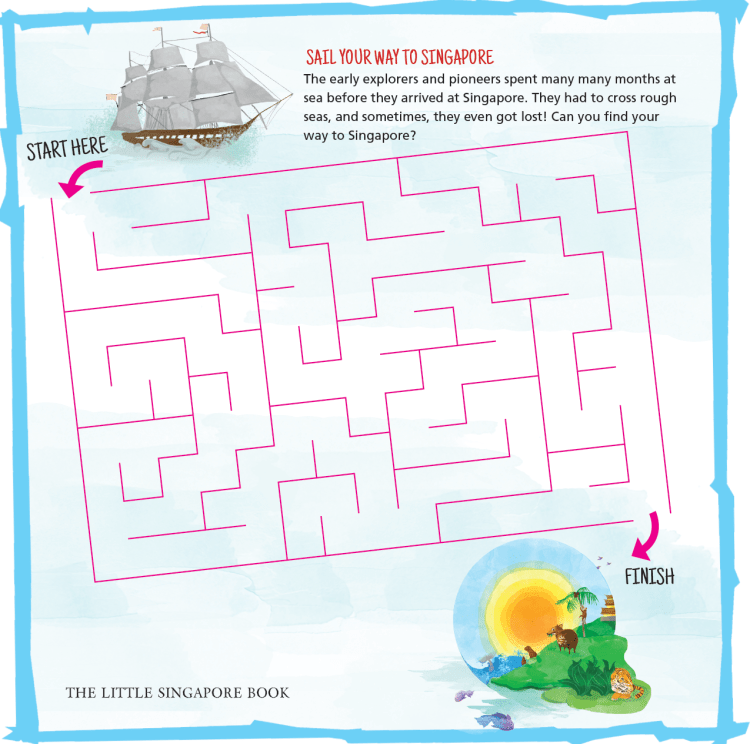
A long long time ago, before air travel became popular and affordable, and before the Causeway and Second Link were built, the only way to reach Singapore was by sea. Many of Singapore’s early immigrants travelled on ships and braved rough seas, bad weather and cramped uncomfortable conditions to get to the island.
It took some of them a very long time to reach Singapore, up to several months. You can bet they were pleased when they finally reached the island!
A Note to Grown-Ups: Here’s an easy activity inspired by our forefathers’ perilous sea journeys. It is perfect for younger children aged five to eight. Click on this link activity book.maze to download the maze below, select ‘fit to page’ on your printer, and print it out for the little ones to sail their way to Singapore!
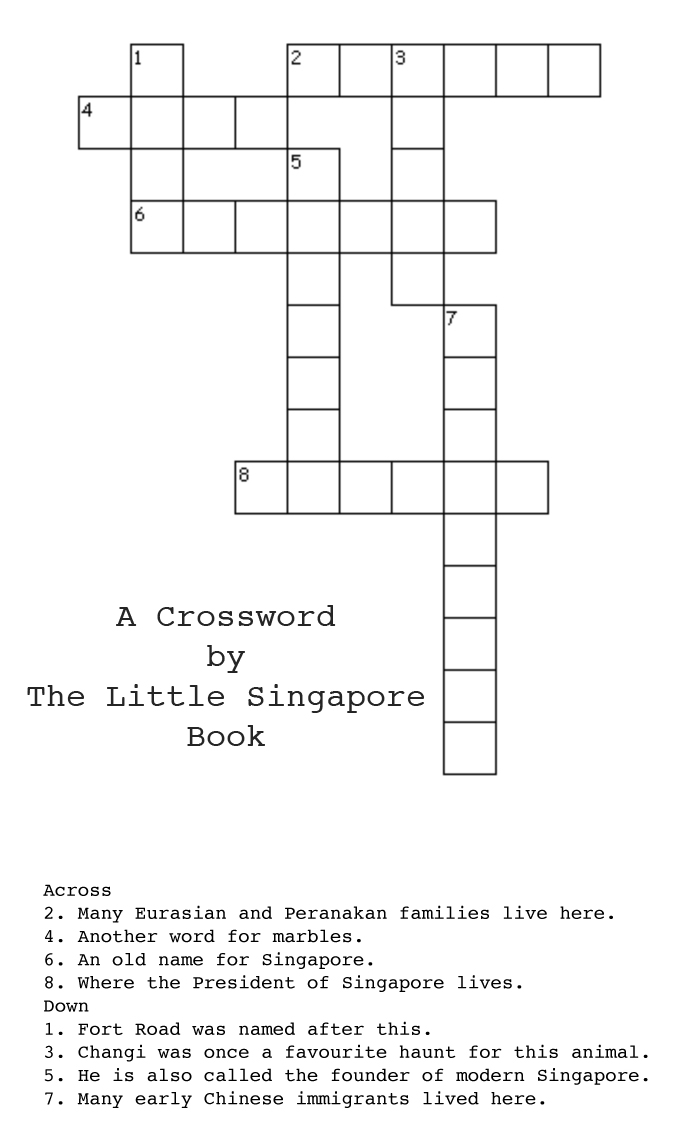
Do you know which animal made Changi its favourite haunt? What is another local name for marbles? Find out how well you know Singapore and its rich history with this quick crossword puzzle, the first in our series of crossword puzzles on Singapore.
A Note to Grown-Ups: Download from the link below, select ‘fit to page’ under printing options, print out and challenge the kids to give it their best shot. Enjoy!
Hint: You’ll find all the answers in The Little Singapore Book (and in the pdf link below). Click on this link to download PuzzleJan2016
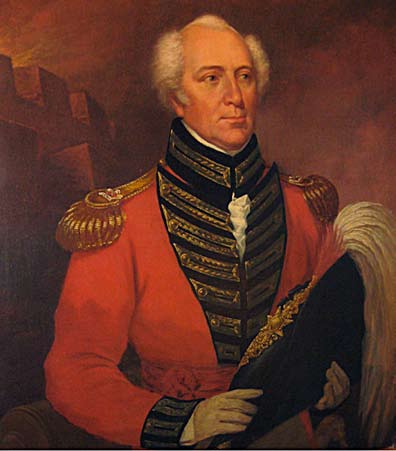
Everyone knows Stamford Raffles as the Founder of Singapore. But in all his life, he only spent 8 months at the longest stretch on our little island. Raffles may have had the grand plans, but it was William Farquhar who stayed on and ruled in Singapore. He worked with the people here and took Singapore from the sleepy fishing village it was to the commercial hub of his time, almost 200 years ago.
William Farquhar, The First Resident and Commandant of Singapore
Born in Scotland, he joined the East India Company as a young man, and spent many, many years in the East. He could speak fluent Malay, and knew the local customs well. He was friendly to everyone – the foreigners and locals alike, and was very well liked. Farquhar was married a lady called Antoinette Clement, the daughter of a French officer and Malay woman. Farquhar and Antoinette had six children together. He was known in his later years in Singapore to have worn a sarong at home instead of western clothes.
By the time he landed in Singapore with Raffles on 28 January 1819, Farquhar had already spent 15 years as the Resident and Commandant of Malacca and was, as you can guess, very familiar with people and culture here. It was he who who discussed the agreement in Malay with the rulers of Singapore to set up a trading post here. (You can see him signing the agreement on page 13 of The Little Singapore Book.) Soon after, Raffles left Singapore while Farquhar stayed on as the First British Resident and Commandant of Singapore. He had the tough job of building up and developing the little island.
It wasn’t easy.
Raffles had declared Singapore a free port, which meant Farquhar could not collect taxes from the merchant ships which came to Singapore to buy and sell goods. Even though the great ships from all over the world sailed in to trade, all that business couldn’t provide Farquhar with money carry out Raffles’ grand plans to turn Singapore into a modern city with all the facilities needed like roads and buildings, drains and canals.
He asked the senior officers (ie. his bosses) in Calcutta, India, for help, but they didn’t want to send money for Singapore. It was so far away and as yet unimportant. Raffles himself was little help as he was in Bencoolen and the postal service was slow and unreliable.
What was Farquhar to do? He needed to get things done. He was given his orders, but he wasn’t given any money or means to earn it, to carry get the job done. He had no choice but to dig into his own pockets to pay for some of the expenses in building up Singapore. In such a difficult situation, he allowed certain not-so-pleasant activities to take place in Singapore, so that he could raise money for the island. Even though Raffles had said from the start they were not to be allowed, Farquhar let people run gambling dens, cockfighting, sell opium, arrack and even slaves! He could tax all these which gave him the money to build the much-needed roads and public works for the island.
Under his rule, High Street, the first road in Singapore, was built. Thick jungles were transformed into profitable gambier, coconut, and nutmeg plantations. As more and more people arrived to live and work here, there soon emerged residential areas with timber houses and wide verandahs, godowns by the Singapore River and many thriving businesses.
By 1820, Singapore had become one the most important trading ports in Southeast Asia!
Once upon a time, the Singapore River was crowded with bumboats. They carried goods such as nutmeg and pepper between the ships moored out at sea and the warehouses, which were also called godowns.
Back in the day, bumboats came in all colours, shapes and sizes. Some were powered by motors, some depended on oars. Others were guided by long poles as they crawled slowly along. Most of them had big rubber tires strapped to their sides, in case they bumped into each other in the busy river. And all of them had “faces” painted on their bow, so that they could “spot” danger.
But lots of traffic meant that the Singapore River got really really dirty. After Singapore became independent, there was a massive national campaign to clean it up and bumboats were eventually banned from it.
These days, you can spot a few bumboats trawling the river. These are river taxis and they now carry only people, not goods.
You can buy lots of sweets and candies in the shops these days. And there are huge shops selling nothing but candy too. But can you imagine that not that long ago, such a sight was not to be seen in Singapore?
Many of the sweets we take for granted now — like the different kinds of fruit gummies, multicoloured lollipops, the whole plethora of candy beans, popping candy, gobstoppers and chocolate candy — were either not available or really hard to find! Back in the 1960s and 70s, children had only a small variety of sweets to enjoy, most of them made in China. And if you were lucky or very good, you may have been treated to a special box of Dolly Mixtures or stretchy black Liquorice, imported all the way from Britain. (These seemed like they came straight out of an Enid Blyton storybook, which kids of the 70s devoured with a passion.)
These days, you can still find lots of the traditional Made-in-China candy in some supermarkets like Sheng Siong. They are not as popular now, but one still remains a favourite. That’s the White Rabbit candy!
Illustrated by Sim Mei-Ann
Do you anything about it? It’s a big favourite during Chinese New Year, with its red, blue and black markings and trademark rabbit drawn on the wrapper. Kids loved to unwrap the sweet and bite off bits of the paper wrapping inside. It’s actually not paper, but a paper-thin layer made of glutinous rice flour. The sweet itself is a sweet, milky, chewy candy that everyone loves.
It was first made over 70 years ago at the ABC Candy Factory in Shanghai in 1943. Someone working there had tasted a milk candy from the United States and liked it. So he took the idea back to the factory, developed a recipe and in half a year, came up with the milk candies.
Note to the grown-ups : A few years ago, the White Rabbit Sweets were affected during the melamine milk food scare in China. Singapore pulled the sweets off the shelves when it was found to have traces of melamine. Since then, the sweets are made using milk from New Zealand, as White Rabbit has for quite some time been back on the supermarket shelves here.
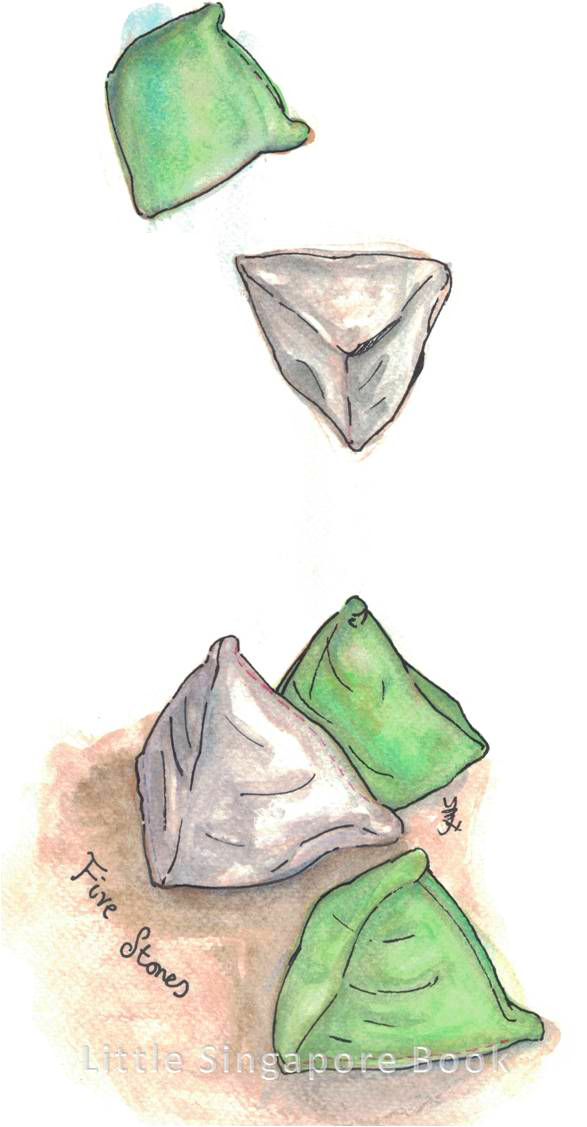
This is one of the most well known games during the early days of Independent Singapore. Almost every school girl would have a set of five stones in her pocket or bag, ready to play with friends.
You’ll need: At least 2 players, a flat surface to play on, and a set of five stones. (They are five triangular cloth ‘bags’ filled the rice, sand or saga seeds. Each should be about the size of a walnut.)
How to play: Complete the 8 steps below. The person who does so with the least number of attempts wins. If a player drops a stone, he forfeits his turn. When his opponent drops a stone, the player can pick up at the step he didn’t complete, starting from the beginning of that step.
#1: Throw down all five stones. Pick up one and throw it in the air, quickly pick a second stone, while the first is still mid air, and catch it while it falls. You should then have 2 stones in your hands. Put one of them aside, and repeat with each of the remaining 3 stones. #2: Do like step 1 but pick up two stones at a time. Put two stones aside and repeat. #3: Repeat step 1 but pick up 3 stones before catching the stone in mid air. Put the 3 stones aside and repeat with remaining stone.
#4: Throw down all five stones. Toss 1 stone in the air, and pick up the remaining four stones at the same time while the first stone is in mid air. Catch it before it lands.
#5: Throw up one stone, and place the other four on the ground. When the stone lands, throw another stone up, grab the four stones and catch the stone before it lands. #6: Throw all five stones on the ground. Pick two stones. Throw one in the air and swap the other with one on the ground, then catch the other stone before it lands. Repeat with the rest of the stones. You’ll be left with 2 stones in your hands.
#7: Throw up the 2 stones from the end of Step 6. Pick up one stone from the ground, and catch the two falling stones separately in each hand. Repeat until you are left with three stones in one hand and two in the other. Throw the two stones and catch it separately in both hands. Throw the remaining stone and catch it with the hand that has all the stones.
#8: Throw down all the stones. Your opponent selects a stone to be thrown in the air. You have to pick this stone without moving any others, then toss it into the air. Pick up the four stones at the same time, then catch the falling stone.
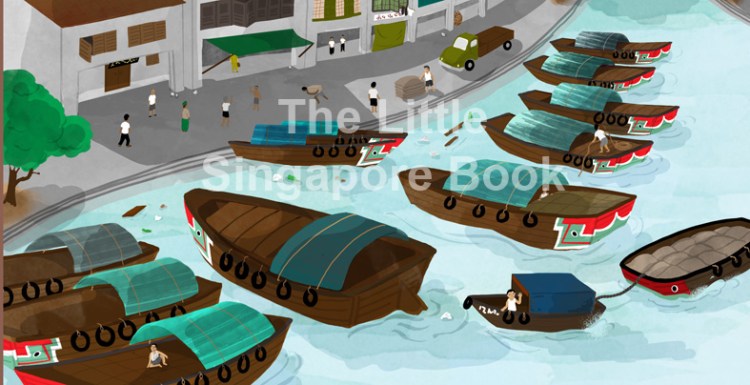 Once upon a time, the Singapore River was crowded with bumboats. They carried goods such as nutmeg and pepper between the ships moored out at sea and the warehouses, which were also called godowns.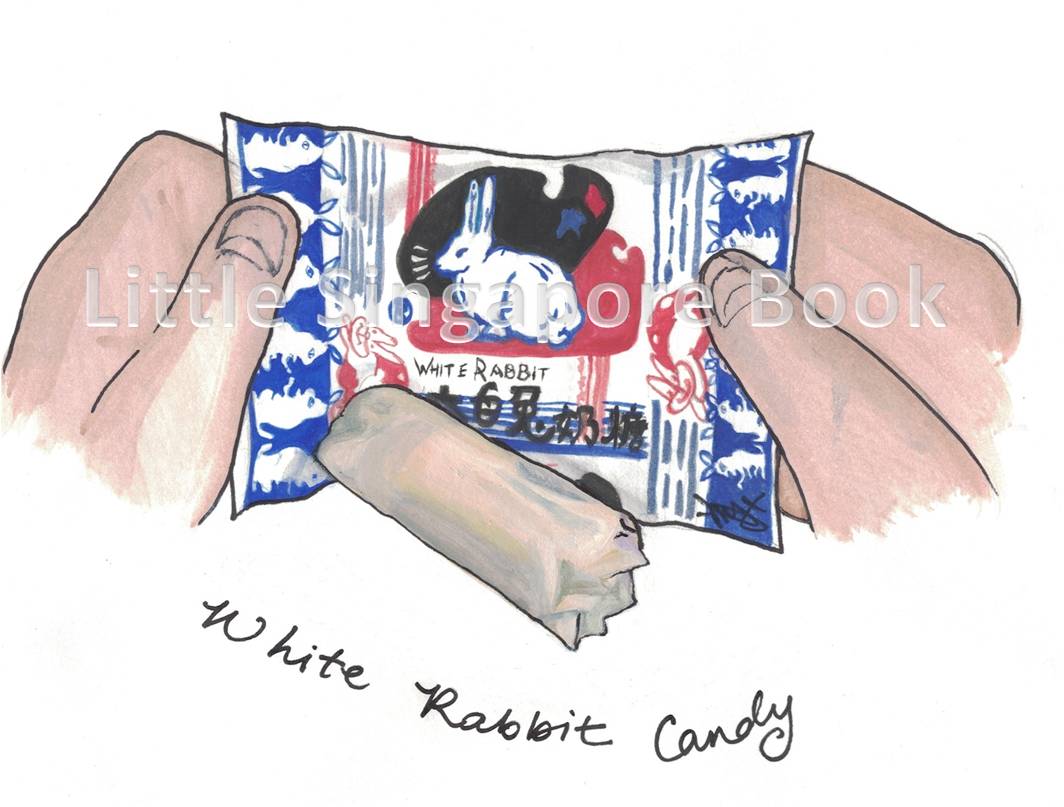
 littlesingaporebook.com
You must be logged in to post a comment.